







Of all the subjects I hated at boarding school, I hated maths the most. In 1998, maths was taught by Mr Manoharan, a sharp-tongued, short man with skin the colour of night. He threw sticks of chalk at us, hit the boys who scored low marks and talked openly about how little he thought of girls. Every day, I’d hunch over in my seat, eyes down, scribbling random numbers in my notebook as he taught. Nothing he said made sense to me. It wasn’t that I didn’t care; I was too afraid to ask. I didn’t want to be humiliated in front of everyone. I was almost thirteen years old, and I didn’t understand numbers – algebra, fractions, geometrical angles, it didn’t matter. When I looked at numbers on a page, I just saw chaos and confusion. There was no logic to why they were written the way they were. I couldn’t figure out why the answers that came so easily to most of my classmates didn’t come to me. So I kept my shameful secret. I never raised my hand and asked a question because I was terrified that I’d be found out, exposed for being stupid. Whenever Mr Manoharan walked past me, he’d peer over my shoulders as I tried to solve a problem and tut and shake his head. No good, he’d tut, females are completely useless.
The words always cut through me: females, useless.
I was female.
I was useless.
At the end of first term, I received a letter. Letters were the only way to communicate with my parents. The school did not allow the use of telephones or emails. Kids had to write a letter home every week. The school distributed any letters that arrived for children during teatime. I took my letter and ran my fingers over the white envelope, unsure if I should open it. I was in the dining hall and the air was filled with chatter. The whole place smelled of cardamom and buttercream. Other girls who had received mail from home were reading their letters. I bit into my cake and poured myself a cup of tea. A hot, sickly sweetness spread over my tongue. Reluctantly, I opened the envelope, glazed over the lines on the pages and then shoved the letter into my pocket. My parents had received my report card. My mother had little to say about home, all she did was ask me to focus on my studies. The words “focus on your studies” sounded just like Mr Manoharan’s words: “Useless.” And once I read that, a maddening rage shot through me, and I lost my appetite. Couldn’t they see that I was struggling? I left the cake, half-eaten, back on the steel plate in front of me. I was focusing on my studies. I was trying my best. Why did they reduce me to my scores just like the teachers at school?
That evening, I opened my maths textbook after study hours and flipped through the pages. I could make no sense of it. The day room was warm. Outside the window, a brisk wind rustled the trees. I looked at the girl near me as she worked on her problems and tried to emulate her. I noticed how she held her pencil and added and subtracted and erased until she solved the equation. Feeling foolish, I too opened my maths notebook and wrote down the question. But I didn’t even understand the question – what did x mean? What did y mean? What did it mean to find the value of x?
I patted the girl on her shoulder and asked if she could help me. She smiled sympathetically and began explaining to me, step by step, how she worked out the problem. I tried to listen to her, but my mind wandered. I couldn’t follow. I paused, tapped at my book and asked her if she could explain it to me again. She looked at me, confused, and asked me what part I’d like to understand better. I looked at the calculations she’d done and burned with embarrassment.
“I mean, how did you get that answer?” I muttered.
“You didn’t understand anything I did?”
I shook my head. She cocked her head to the side and opened a fresh page. I watched her bite her lip and take a moment to consider how she should teach me. Then, she picked up her pencil and said gently, “Okay, I’ll work it out step by step again, just look closely. It’s very easy.”
Five minutes later, after she was done explaining it to me like I was a kindergartner, she sat up graciously and said, “See? It’s easy, no?”
I looked at her notes and still couldn’t figure out what she’d done. It was as if a smoky fog descended inside my brain and the numbers dissolved in its darkness. I felt a pang of jealousy. I suddenly wanted to be in this girl’s head, to think the way she thought. My own brain felt insufficient, partly damaged. How did Mr Manoharan’s words not get to her?
“Yeah, that’s so easy,” I lied.
“Cool,” she said, a triumphant look on her face. Then she stood up, straightened her school uniform, and left the room. When she’d gone, and I was certain she was out of sight, I took my maths notebook and copied the calculations she’d made in her book. Then, I feverishly turned to the page on which she’d made rough calculations earlier and copied that too. I ignored the guilt that tugged at me and told myself that I’d try to learn it again when I had time. For now, I had to complete my homework. The next day, I sat at my desk tapping my pen impatiently until maths period. I wanted to get through it and be done. Mr Manoharan came in through the doors, cursing the weather. Then he turned to the class and asked us to open our books to show him our homework.
Silently, he walked around, inspecting everyone’s answers. When he came up near me, I froze. My mouth went dry. I don’t know if it was the sound of his tongue-flicking or the smell of chalk from his teacher’s cloak, but my whole body wilted like a peony blossom in the summer heat.
“You did those calculations?” he smirked.
I nodded. “Yes, sir.”
“How did you get that answer?”
My fingers trembled. I flipped to the last page of my notebook and showed him the calculations that I’d copied from my classmate the night before. I was so terrified I worried I might throw up. I hoped he wouldn’t ask me to rework the problem on the blackboard in front of the whole class.
But Mr Manoharan simply shook his head, “You did that?” and walked away, uninterested, before I could reply.
I burned with shame.
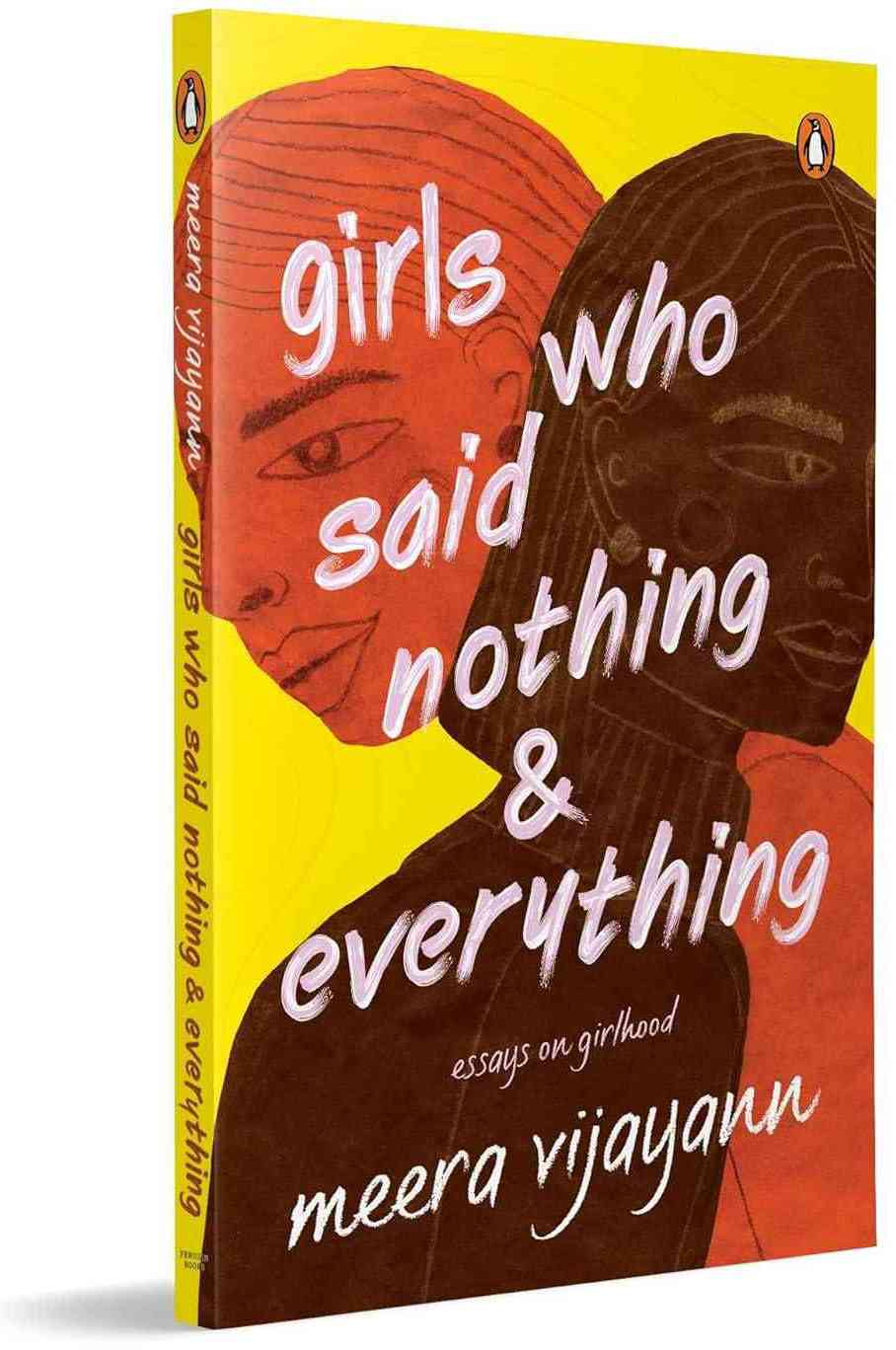
Excerpted with permission from Girls Who Said Nothing and Everything: Essays on Girlhood, Meera Vijayann, Penguin India.
